.png)

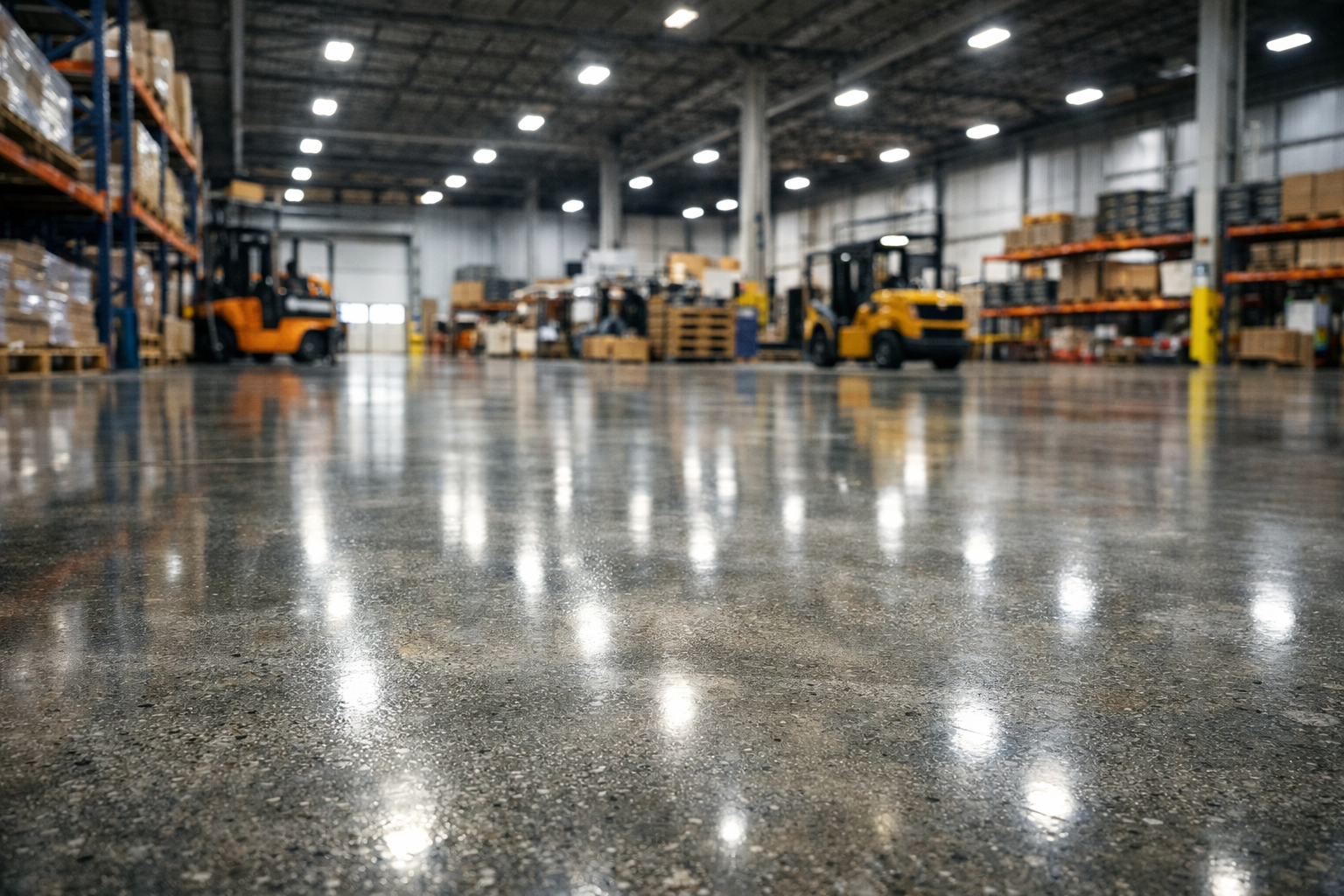
Industrial floors are not decorative features. They are working surfaces that support daily operations, equipment movement, employee safety, and overall productivity. When a floor begins to fail, the impact reaches far beyond appearance. Cracks collect debris, coatings peel under traffic, and uneven surfaces slow down workflows or create safety hazards.
Facility owners and managers across warehouses, manufacturing plants, and distribution centers are increasingly turning to polished concrete because it is built to endure. Rather than masking problems with a surface coating, polished concrete improves the performance of the concrete slab itself.
Understanding why polished concrete is so durable starts with how it is created and how it responds to real-world industrial demands.
What Polished Concrete Really Is
Polished concrete is not a coating or an overlay. It is a process that transforms an existing concrete slab into a dense, hardened, and smooth surface.
The process includes:
- Mechanical grinding to remove surface imperfections and weak concrete
- Application of a liquid densifier that penetrates the slab
- Progressive polishing to achieve the desired finish level
The densifier reacts chemically with the concrete, filling pores and increasing surface hardness. The polishing stages further tighten the surface, making it more resistant to abrasion and moisture intrusion.
Because the finished floor is the concrete itself, there is no separate layer that can peel, delaminate, or wear unevenly under heavy traffic.
Designed to Handle Heavy Equipment Traffic
Industrial facilities rely on forklifts, pallet jacks, carts, and other wheeled equipment. These loads concentrate pressure at contact points, especially along forklift travel paths.
Polished concrete performs exceptionally well under these conditions because:
- The hardened surface resists abrasion from rubber and polyurethane wheels
- The smooth finish reduces friction and uneven wear
- Load distribution remains consistent across the slab
Unlike epoxy or painted coatings that eventually wear through, polished concrete maintains its integrity even as traffic increases.
Resistance to Cracking, Chipping, and Surface Failure
All concrete can crack, but polished concrete minimizes surface-level deterioration.
During the grinding process, weak surface layers are removed. Densification strengthens the remaining concrete, reducing dusting and surface breakdown. When joints and cracks are properly addressed, the finished floor remains stable and uniform.
This results in:
- Fewer chips and surface defects
- Reduced concrete dust
- A cleaner, safer working environment
Lower Maintenance Demands Over Time
One of the most practical benefits of polished concrete is how little maintenance it requires.
Traditional industrial flooring often demands:
- Recoating cycles
- Frequent repairs
- Specialized cleaning products
Polished concrete maintenance is simple. Routine cleaning with neutral cleaners and occasional burnishing is usually sufficient.
This reduces labor costs, limits downtime, and simplifies facility upkeep.
Moisture and Chemical Resistance
Polished concrete is less porous than untreated concrete, which helps limit moisture absorption from spills and cleaning.
It offers strong resistance to:
- Water and routine cleaning solutions
- Oils and lubricants
- Light chemical exposure when cleaned promptly
For facilities with heavier chemical demands, polished concrete can also serve as a durable base for additional protective systems.
Long-Term Cost Efficiency
Durability is also about cost over time.
Polished concrete delivers strong long-term value because:
- It uses the existing concrete slab
- It eliminates recurring coating replacement
- It lowers maintenance and repair expenses
Many facilities find that polished concrete reduces total ownership costs over the life of the floor.
Safety and Visibility Benefits
Polished concrete reflects ambient light, improving visibility in large facilities. This can reduce the need for additional lighting.
Slip resistance can be adjusted based on finish level, allowing facilities to meet safety requirements without compromising durability.
Industrial floors must perform every day without interruption. Polished concrete delivers durability, reliability, and long-term value by strengthening the concrete itself.
For facilities planning new construction or upgrading existing floors, polished concrete is a practical investment in performance and longevity.